
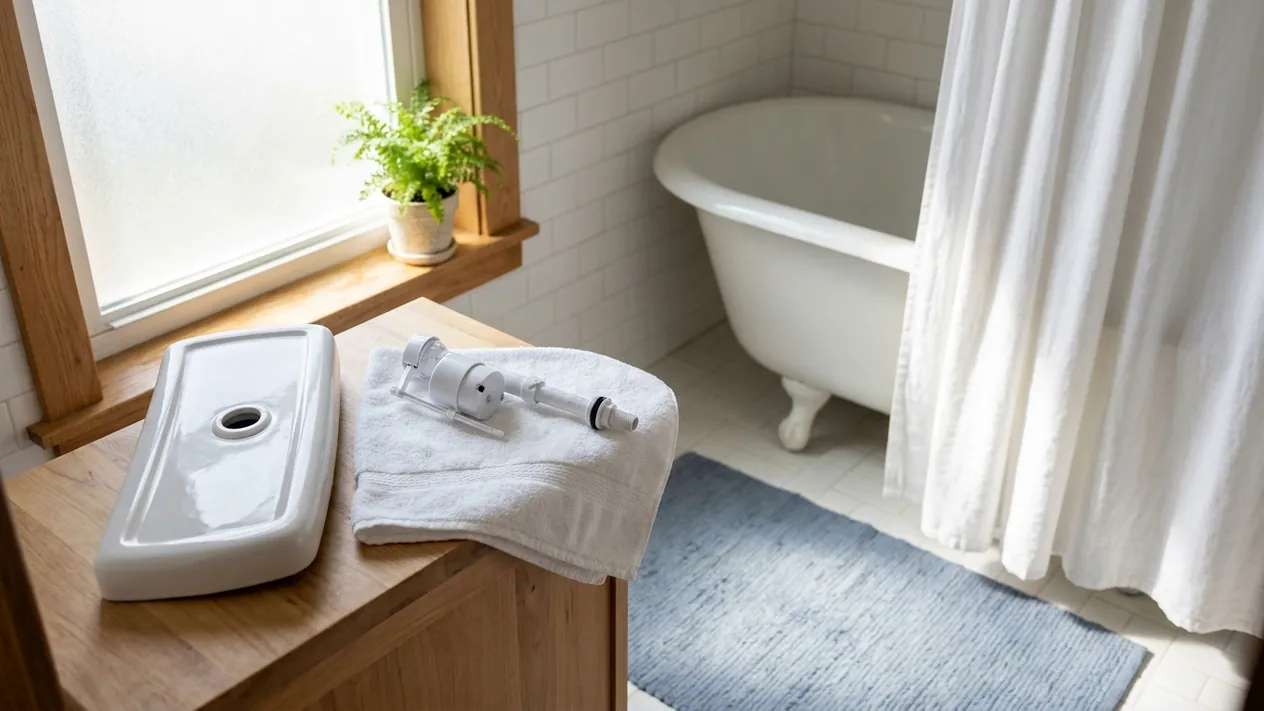
A toilet fill valve that won't stop running, fills too slowly, or whistles is one of the most common plumbing problems in any home. The fill valve controls how the tank refills after a flush, and when it fails the toilet wastes water around the clock, 200 gallons a day or more. Adjusting or replacing it is one of the easiest plumbing repairs there is: no soldering, no special tools, no experience needed.
Is it the fill valve or the flapper? Check this first
Two parts cause nearly every running toilet, and they are fixed differently. The flapper is the rubber flap at the bottom of the tank that lifts when you flush; the fill valve is the tall tower on the left that refills the tank. Here is how to tell them apart in two minutes:
- Lift the tank lid and look at the water level. If water is spilling into the top of the overflow tube (the open pipe in the middle of the tank), the fill valve is not shutting off. That is a fill valve or float problem: this article.
- Water level is fine, but the toilet runs for a few seconds every so often ("phantom flushing"). Water is leaking past the flapper into the bowl, the tank drops, and the fill valve tops it up. That is a flapper, a part that snaps on in five minutes.
- Food-coloring test: put a few drops in the tank, do not flush, and wait 15 minutes. Color in the bowl means the flapper leaks. No color and still running means the fill valve.
- Slow fill or whistling, no running: the fill valve is clogged with sediment or failing. Clean it (section below) or replace it.
Signs Your Toilet Fill Valve Needs Attention
Here are the most common symptoms that point to a fill valve problem:
- Toilet runs constantly: You hear water running even when nobody has flushed. The fill valve isn't shutting off because the float mechanism is stuck or the seal is worn.
- Toilet runs intermittently (phantom flushing): The toilet randomly runs for a few seconds every 10 to 15 minutes. This usually means the flapper is leaking, but a faulty fill valve can also cause it.
- Tank fills very slowly: The valve is partially clogged with sediment or mineral deposits, restricting water flow.
- Whistling or whining sound during fill: The valve's internal seal is deteriorating, causing water to vibrate as it passes through.
- Water level is too high or too low: The float isn't set correctly, causing the tank to overfill (water runs into the overflow tube) or underfill (weak flush).
Tools and Materials You'll Need
This is a simple repair that requires minimal tools. Check our essential home toolkit guide to make sure you're equipped for this and other basic home repairs.
- Adjustable wrench or channel-lock pliers
- Replacement fill valve: we recommend the Fluidmaster 400A (around $8 to $12 at any hardware store). It's the industry standard, fits virtually all toilets, and has been proven reliable for decades.
- Small bucket or towels: for water that drains when you disconnect the supply line
- Sponge: to soak up remaining water in the tank bottom
Estimated time: 20 to 30 minutes for a full replacement. 5 minutes for a float adjustment.
Option 1: Adjusting the Fill Valve (Try This First)
Before replacing the entire valve, try adjusting it. Many fill valve issues are simply a matter of float height: the water level is set too high or too low.
Identifying Your Fill Valve Type
There are two main types of fill valves you'll encounter:
- Ball float (ballcock): An older design with a large ball on the end of a metal arm. The ball rises with the water level and triggers the valve to shut off. These are found in toilets from the 1960s through the 1990s.
- Cup float (modern): A cylindrical float that rides up and down on the valve body itself. The Fluidmaster 400A is this type. Most toilets made after 2000 use this design.
Adjusting a Ball Float
- Remove the tank lid and set it on a towel (porcelain chips easily).
- Locate the float ball at the end of the metal arm.
- To raise the water level, bend the arm slightly upward. To lower it, bend the arm slightly downward.
- Flush and observe. The water level should stop about 1 inch below the top of the overflow tube.
Adjusting a Cup Float (Fluidmaster-style)
- Remove the tank lid.
- Find the adjustment screw or clip on the float mechanism (it's on the side of the valve body where the float cup rides).
- To raise the water level, turn the adjustment screw clockwise (or squeeze the clip and slide the float up). To lower it, do the opposite.
- Flush and observe. Aim for a water level about 1 inch below the overflow tube.
If adjusting the float doesn't fix the problem (the valve still won't shut off, it whistles, or it fills sluggishly), it's time for a full replacement.
Option 2: Replacing the Fill Valve (Fluidmaster 400A)
Replacing a fill valve sounds intimidating but it's genuinely straightforward. If you can turn a wrench, you can do this.
Step 1: Turn Off the Water Supply
Locate the shutoff valve on the wall or floor behind the toilet (left side, near the base). Turn it clockwise until it stops. This is usually an oval-handled valve or a quarter-turn ball valve.
Step 2: Flush and Drain the Tank
Flush the toilet to drain most of the water from the tank. Hold the handle down to drain as much as possible. Use a sponge to soak up the remaining water from the tank bottom. Place your bucket or towels under the supply line connection at the bottom of the tank.
Step 3: Disconnect the Water Supply Line
Use your adjustable wrench to loosen the supply line nut where it connects to the bottom of the fill valve (outside the tank, underneath). Water will drip out. That's what the bucket and towels are for. Set the supply line aside.
Step 4: Remove the Old Fill Valve
Inside the tank, you'll see the fill valve secured by a large plastic nut on the outside bottom of the tank. Hold the valve body from inside the tank with one hand, and unscrew the mounting nut from underneath with the other hand (or use pliers). Lift the old valve out of the tank.
Step 5: Adjust the New Valve Height
The Fluidmaster 400A is height-adjustable. Hold it next to the overflow tube inside the tank. The "CL" (critical level) mark on the valve should sit about 1 inch above the top of the overflow tube. Twist the valve body to adjust the height, then lock it in place.
Step 6: Install the New Fill Valve
- Place the rubber shank washer (included) onto the bottom of the new valve, with the beveled side facing down toward the tank hole.
- Insert the valve through the hole in the bottom of the tank.
- From underneath, hand-tighten the mounting nut. Then snug it with pliers, one-half turn past hand-tight is enough.
Step 7: Connect the Supply Line
Reconnect the water supply line to the fill valve shank underneath the tank. Hand-tighten the nut, then snug it with your wrench. Do not overtighten. You're threading plastic into plastic.
Step 8: Attach the Refill Tube
The small rubber tube that comes with the valve clips onto the overflow tube. This sends a small stream of water into the bowl during refill (it's what replenishes the bowl water level). Clip the included angle adapter onto the top of the overflow tube and insert the refill tube into it. The tube should not extend down into the overflow tube. Just clip it to the top.
Step 9: Turn On the Water and Test
Slowly turn the shutoff valve counterclockwise to restore water. Let the tank fill completely. Check underneath for any leaks at the supply line connection and mounting nut. Flush several times and verify the fill valve shuts off cleanly and the water level sits about 1 inch below the overflow tube.
Step 10: Fine-Tune the Water Level
If the water level is too high or too low, use the adjustment screw on the top of the Fluidmaster valve. Turn clockwise to raise the level, counterclockwise to lower it. Flush again to confirm.
Common Mistakes When Replacing a Fill Valve
- Not turning off the water first: It sounds obvious, but in a rush you might forget. You'll end up with water spraying everywhere the moment you remove the old valve.
- Overtightening the mounting nut: The nut is plastic, the tank is porcelain. Overtightening can crack the tank, and a cracked toilet tank means replacing the entire toilet. Hand-tight plus a half turn with pliers. That's it.
- Setting the wrong height: If the CL mark is below the overflow tube, water can siphon back into the tank and the valve may not function properly. Always set the CL mark 1 inch above the overflow tube.
- Pushing the refill tube into the overflow tube: The refill tube should clip to the top of the overflow tube, not insert down into it. If it's pushed inside, it can create a siphon that continuously drains the tank.
- Reusing the old supply line: If your supply line is an older chrome or plastic rigid tube, consider replacing it with a braided stainless steel flexible supply line (around $5 to $8). They're much easier to connect and far less likely to leak or burst.
Troubleshooting After Replacement
| Problem | Likely Cause | Fix |
|---|---|---|
| Leak at tank base | Mounting nut not sealed or washer misaligned | Remove valve, reseat washer, retighten |
| Leak at supply line | Nut not tight enough or cross-threaded | Disconnect, realign, reconnect carefully |
| Valve won't shut off | Float set too high or debris in valve | Lower float adjustment; remove cap and rinse |
| Weak flush | Water level too low | Raise float to set water level 1 inch below overflow |
| Whistling sound | Valve cap not seated properly | Remove cap, clean seal, reseat firmly |
How to Clean a Fill Valve Without Replacing It
If your valve is relatively new but filling slowly, sediment may be the problem. Most modern fill valves (including the Fluidmaster 400A) have a removable top cap:
- Turn off the water supply.
- Remove the valve cap by pressing down and twisting counterclockwise (about a quarter turn).
- Lift out the cap and the internal seal.
- Hold a cup upside-down over the uncapped valve and briefly turn the water on. Water will flush debris out of the valve body into the cup.
- Rinse the seal under running water, removing any grit or mineral deposits.
- Reassemble the cap and seal. Turn water back on and test.
What a plumber charges for a running toilet around Louisville
If you would rather hand it off, a plumber in Louisville, Jeffersonville or New Albany will usually replace a fill valve and flapper for roughly $100 to $250 including the parts, most of it the trip and the first hour. It is often worth asking them to check the shutoff valve behind the toilet and the supply line while they are there, since those are the two things that fail next. Local plumbers are listed here, free to call.
Common questions
How do I know if my fill valve is bad?
Water running into the overflow tube with the tank full, a toilet that takes minutes to fill, hissing or whistling that will not stop, or a float that no longer changes anything when you adjust it. Any of those means adjust it first, then replace it.
Can I just adjust it instead of replacing it?
Often, yes. On a cup-float valve, pinch the clip on the float rod and slide the cup down to lower the water level. On an old ball float, bend the arm down slightly. If the water still creeps up to the overflow tube after adjusting, the seal inside the valve is worn and it is time for a new one.
Does it matter which fill valve I buy?
Not much. The Fluidmaster 400A fits almost every two-piece toilet and is what most plumbers carry. Korky and Kohler-branded valves are fine too. Buy the kit that includes a new flapper and do both at once.
How much water does a running toilet waste?
The EPA's figure is up to 200 gallons a day, about 6,000 gallons a month. On Louisville Water or an Indiana American Water bill that shows up as a noticeably higher month, and it keeps going until you fix it.
When to Call a Pro
If you've replaced the fill valve and the problem persists, it's time to call a licensed plumber. Find trusted plumbers in New Albany, Clarksville, and across the Kentuckiana region.
A fill valve replacement is well within DIY territory, but call a plumber if:
- The shutoff valve behind the toilet won't turn or leaks: replacing a shutoff valve involves soldering or working with the main water line.
- The toilet tank is cracked: a cracked tank can't be repaired. You'll need a new toilet.
- The toilet rocks or leaks at the base: this is a wax ring or flange issue, not a fill valve problem. It requires pulling the toilet.
- You've replaced the fill valve and flapper but the toilet still runs: the overflow tube or flush valve assembly may need replacement, which is a more involved repair.
Most toilet fill valve problems are a $10 fix and 30 minutes of your time. A running toilet wastes roughly 6,000 gallons per month, which can add $50 or more to your water bill. Fixing it pays for itself immediately.
A running toilet is one of those problems that's easy to ignore because it's not an emergency. But every day you let it run is money flowing straight down the drain. Grab a Fluidmaster 400A, set aside half an hour, and knock this out. You'll wonder why you waited so long.