
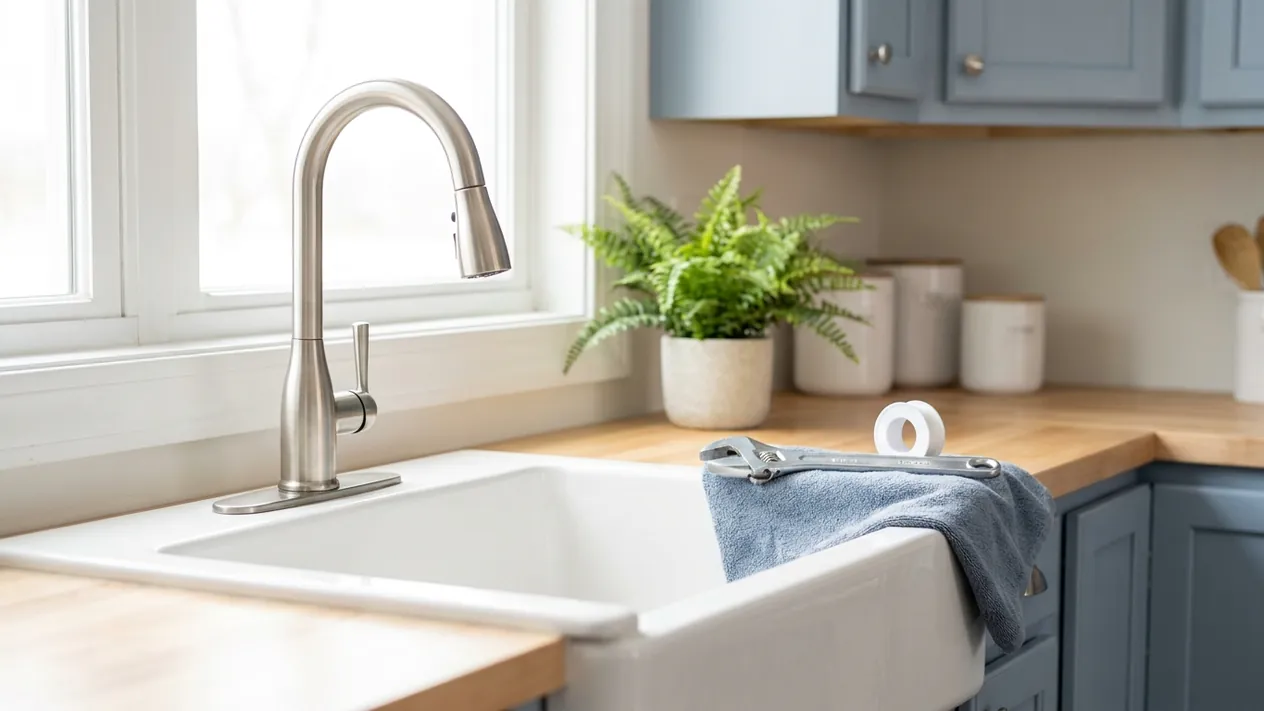
Last week I got a call from a buddy over in New Albany. "Mike, my kitchen faucet's been dripping for three months. The plumber wants $350. Can I do this myself?" I told him what I'm about to tell you: absolutely. Replacing a faucet is one of the most satisfying DIY plumbing jobs out there. It requires no special skills, no expensive tools, and if you follow these steps, you'll have it done before your morning coffee gets cold.
If you're losing sleep over that steady drip-drip-drip -- or watching your Louisville Water Company bill climb every month -- this guide is for you. And if you hit a snag along the way, find a trusted plumber near you through our directory.
What You'll Need Before You Start
Gather everything before you crawl under the sink. Nothing kills your momentum like a mid-job trip to the hardware store. Here in the Kentuckiana area, Lowe's on Dixie Highway, the Home Depot off Clarksville's Veterans Parkway, or your local Ace Hardware will carry everything on this list.
Tools
- Adjustable wrench (one large, one medium)
- Basin wrench -- this is the one tool most people don't own, and it's worth every penny of the $15-$25 price tag
- Channel-lock pliers
- Bucket and old towels
- Flashlight or headlamp
- Plumber's tape (Teflon tape)
- Penetrating oil (PB Blaster or WD-40)
Parts
- New faucet (with supply lines included -- most modern faucets come with braided stainless steel lines pre-attached)
- Plumber's putty or silicone sealant
- New supply lines if yours are older than 10 years and the faucet doesn't include them
How Long Will This Take?
For a straightforward swap with no complications: 30 to 60 minutes. If your old faucet has corroded nuts or you're dealing with galvanized supply lines from the 1970s -- common in older Jeffersonville and Louisville homes -- budget an extra 30 minutes for soaking those connections with penetrating oil.
Step 1: Shut Off the Water
Look under the sink for two shut-off valves -- one for hot, one for cold. Turn them clockwise until they stop. Then open the faucet to release any pressure and drain remaining water.
If your shut-off valves are frozen (won't budge) or they don't exist (older homes sometimes skip them), you'll need to shut off the main water supply to the house. In most Kentuckiana homes, the main shutoff is in the basement near where the water line enters the building, or in a utility closet on the ground floor.
Step 2: Disconnect the Supply Lines
Place your bucket under the supply line connections. Use your adjustable wrench to loosen the nuts connecting the supply lines to the shut-off valves. Water will drain out -- that's what the bucket is for.
If the supply lines connect directly to the faucet tailpieces above, disconnect those too. On older installations, you might find rigid chrome supply tubes. These are a pain to work with and I'd recommend replacing them with flexible braided lines while you're at it.
Step 3: Remove the Old Faucet
This is the step that makes people nervous, and honestly, it's where the basin wrench earns its keep. You need to remove the mounting nuts holding the faucet to the sink from underneath.
- Crawl under the sink with your flashlight. Look up at the underside of the faucet -- you'll see large mounting nuts threaded onto the faucet tailpieces.
- If the nuts are corroded, spray them with penetrating oil and wait 10-15 minutes. Seriously, wait. Forcing a corroded nut will round it off and make your life miserable.
- Use the basin wrench to grip the nut and turn counterclockwise. The basin wrench has a long shaft specifically designed for reaching up into tight spaces behind the sink basin.
- Remove the mounting nuts and any washers or hardware.
- Lift the old faucet straight up and out from the top of the sink.
While the faucet is out, clean the sink surface around the mounting holes. Old plumber's putty, mineral deposits, and gunk build up over the years. A plastic scraper and some white vinegar will handle most of it.
Step 4: Prep the New Faucet
Read the instructions that come with your new faucet. I know, I know. But every manufacturer does things slightly differently, and five minutes reading the manual can save you twenty minutes of trial and error.
Most faucets need a gasket or a bead of plumber's putty between the faucet base plate and the sink surface to create a watertight seal. Some faucets include a rubber or foam gasket -- if yours does, skip the putty and use the gasket. If it doesn't, roll plumber's putty into a rope about the thickness of a pencil and press it around the base of the faucet.
Thread the supply lines and any other hardware down through the mounting holes before you set the faucet in place. It's much easier to feed them through from above than to fish them up from below.
Step 5: Mount the New Faucet
- Set the faucet into position from above, feeding the supply lines and tailpieces through the sink holes.
- Make sure the faucet is centered and aligned the way you want it. Once you tighten the mounting hardware, repositioning is a hassle.
- Crawl back under the sink. Thread the mounting nuts onto the tailpieces by hand first -- always hand-tight before you bring in the wrench.
- Tighten the mounting nuts with your basin wrench. Snug them firmly but don't go gorilla on them. Over-tightening can crack a porcelain or composite sink.
- Check the faucet from above. Is it still centered? Does the handle or spout move freely? Good.
Step 6: Connect the Supply Lines
If your new faucet came with pre-attached braided supply lines (most do these days), connect them to the shut-off valves. Wrap the valve threads with two or three wraps of plumber's tape first -- clockwise, in the direction of the threads.
Hand-tighten the supply line nuts onto the valves, then give them a quarter turn with your wrench. That's it. Over-tightening supply line connections is one of the most common mistakes I see, and it actually causes leaks by deforming the rubber washer inside the fitting.
Step 7: Test for Leaks
This is the moment of truth. Keep your bucket in place and your towels handy.
- Slowly open the shut-off valves -- hot first, then cold.
- Let the faucet run for 30 seconds. The water may sputter at first as air clears out of the lines. That's normal.
- With the water running, get under the sink with your flashlight and check every connection point: supply line to valve, supply line to faucet, and around the faucet base where it meets the sink.
- Shut the faucet off and check again. Some leaks only show when the faucet is closed and pressure builds in the line.
- Dry everything off, lay a paper towel under the connections, and check back in an hour. If the paper towel is dry, you're golden.
When to Skip the DIY and Call a Professional
I'm a big believer in homeowners handling what they can. But there are situations where calling a licensed plumber is the smart move:
- Corroded or frozen shut-off valves that won't close -- you could flood your kitchen trying to force them
- Galvanized steel pipes that crumble when you touch them -- disturbing old galvanized plumbing can open a can of worms
- Leaks behind the wall -- if the drip is coming from inside the wall rather than the faucet itself, that's a different repair entirely
- Low water pressure after installation that you can't resolve -- could indicate a deeper issue in the supply lines
- Permit requirements -- a simple faucet swap doesn't require a permit in Clark, Floyd, or Jefferson County, but if the job scope creeps into re-piping, check with your local building department
How Much Does a Faucet Replacement Cost?
Here's the math for a DIY replacement in the Kentuckiana area as of early 2026:
- Budget faucet: $50-$80 (basic chrome single-handle)
- Mid-range faucet: $120-$250 (Moen, Delta, Kohler -- pull-down sprayer, solid build)
- High-end faucet: $300-$600 (touchless, commercial-style, designer finishes)
- Basin wrench: $15-$25 (one-time purchase)
- Plumber's tape and putty: $5-$8
- Supply lines (if needed): $8-$15 per pair
Total DIY cost: $75 to $300 depending on the faucet you choose. Compare that to hiring a plumber, which runs $200-$400 for labor alone in the Louisville metro area, plus the cost of the faucet. You're saving $200 or more by doing it yourself.
Common Mistakes to Avoid
- Skipping the bucket. There is always residual water in the lines. Always.
- Over-tightening connections. Snug plus a quarter turn. That's the rule. More than that and you're asking for cracked fittings or stripped threads.
- Forgetting plumber's tape. It takes 10 seconds to wrap the threads and prevents slow drips that show up days later.
- Buying the wrong faucet size. Measure your sink holes and the spacing between them before you shop. Standard centerset spacing is 4 inches; widespread is 8 inches.
- Not testing before cleanup. Don't put everything back under the sink, close the cabinet doors, and call it done. Test first, verify no leaks, then clean up.
Wrapping It Up
Replacing a leaky faucet is one of those jobs that sounds harder than it is. The hardest part is usually getting the old one off -- and penetrating oil solves that 90% of the time. Once the old faucet is out, installing the new one is practically plug-and-play.
You don't need a plumbing license. You don't need expensive tools. You need a basin wrench, an hour of your Saturday, and the willingness to crawl under the sink. That drip you've been ignoring? It's wasting roughly 3,000 gallons of water a year. At Louisville Water Company rates, that's real money walking down the drain.
Got a faucet job that turned into something bigger? No shame in that -- it happens to all of us. Find a licensed plumber in your area who can take it from here.
-- Mike Raines has been turning wrenches professionally since 2003. He holds active contractor licenses in Kentucky and Indiana and has completed over 2,000 residential plumbing, electrical, and remodeling projects across the Louisville metro area.