
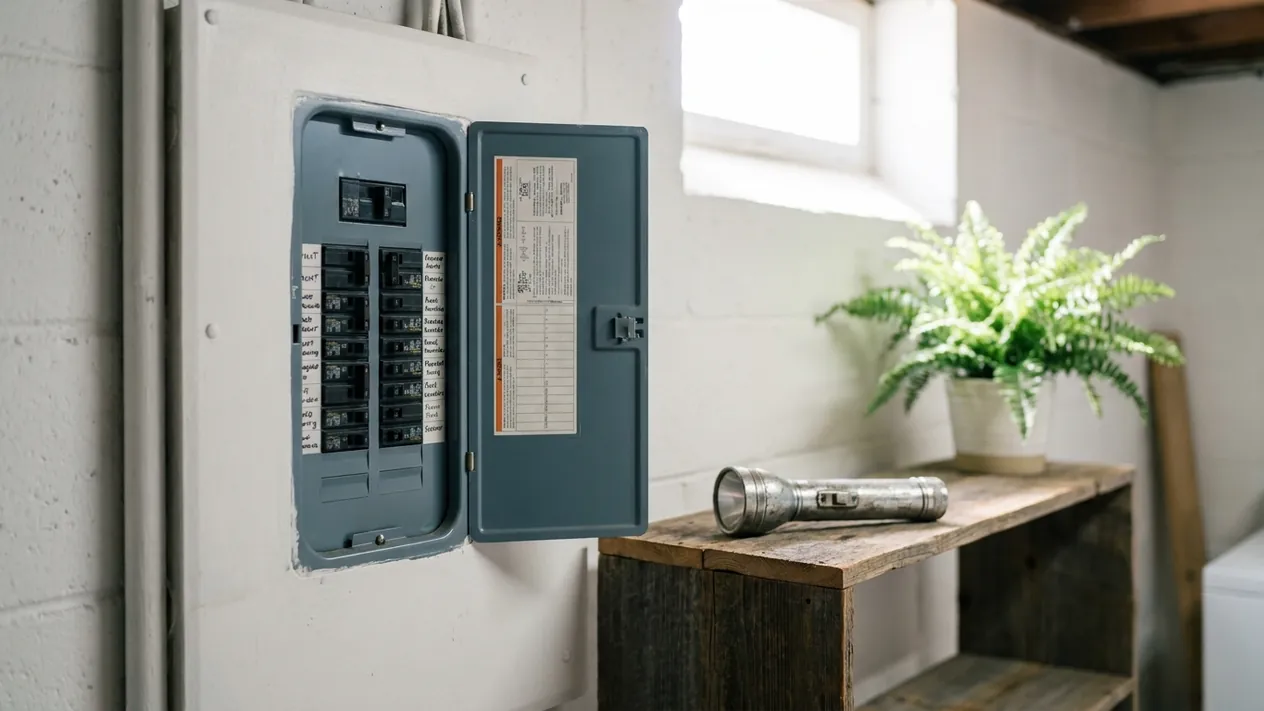
The Gray Box That Runs Your Whole House
Your electrical panel is probably the most important piece of equipment in your home that you never think about. It sits in a basement, garage, or utility closet, quietly splitting incoming power from the utility into individual circuits that feed every outlet, light fixture, and appliance under your roof. When something trips, you flip a breaker and move on. But understanding what's actually happening inside that metal box can save you money, keep your family safe, and help you have a smarter conversation with an electrician when you need one.
I've been working on homes in the Louisville metro and Southern Indiana area for over 20 years, and I'll tell you straight: the panel is where most homeowners' electrical knowledge stops. That's fine for day-to-day life, but it becomes a real problem when something goes wrong and you don't know what you're looking at. Let's fix that.
What Your Electrical Panel Actually Does
Power arrives at your home from the utility through a service entrance cable, usually at 200 amps for newer homes or 100 amps for older construction. That cable feeds into your main breaker panel, which does two critical jobs:
- Distributes power across individual circuits throughout the house
- Protects each circuit from drawing more current than the wiring can safely handle
Think of it like a water manifold. The main line comes in with full pressure, and the panel splits it into smaller lines, each with its own shutoff valve. Except instead of water, you're dealing with electricity, and instead of shutoff valves, you have circuit breakers that trip automatically when something draws too much current.
Every circuit breaker in the panel is sized to match the wire gauge on that circuit. A 15-amp breaker protects 14-gauge wire. A 20-amp breaker protects 12-gauge wire. A 30-amp or 40-amp breaker handles larger loads like your dryer, range, or HVAC system. This sizing relationship is non-negotiable. If someone puts a 20-amp breaker on a 14-gauge wire, that wire can overheat before the breaker ever trips. That's how electrical fires start.
Know Your Breaker Types
Not all breakers in your panel do the same thing. Here's what you'll typically find:
Standard Circuit Breakers (Single-Pole)
These are the narrow, single-width breakers that make up most of your panel. Each one controls a 120-volt circuit and is rated for 15 or 20 amps. They feed your general-purpose outlets, lighting circuits, and small appliances. When one trips, it moves to a middle position between ON and OFF.
Double-Pole Breakers
These take up two slots and deliver 240 volts for heavy-draw appliances: your electric dryer, range, water heater, or central A/C compressor. They're typically rated at 30, 40, or 50 amps. Both poles trip together, cutting power to both hot legs of the circuit simultaneously.
GFCI Breakers
Ground Fault Circuit Interrupter breakers have a small test button on the face. They monitor the balance between hot and neutral current on the circuit. If even a tiny amount of current leaks to ground (like through your body if you touch a live wire while standing in water), the breaker trips in a fraction of a second. Code requires GFCI protection in bathrooms, kitchens, garages, outdoor outlets, and any area near water.
You might also have GFCI outlets (the ones with the test/reset buttons right on the receptacle) instead of GFCI breakers. Both accomplish the same thing. In the Louisville and Southern Indiana market, I see a mix of both in homes built after the mid-1990s.
AFCI Breakers
Arc Fault Circuit Interrupter breakers detect dangerous electrical arcs, the kind caused by damaged wire insulation, loose connections, or a nail driven through a wire inside a wall. They also have a test button, and modern electrical code requires them on most bedroom and living area circuits. Homes built or substantially remodeled after 2014 in Indiana and Kentucky should have AFCI protection on most branch circuits.
The Main Breaker
The big double-pole breaker at the top (or bottom) of the panel is the main disconnect. It controls everything. Flipping this off cuts all power to your entire house. You'd use this in an emergency, such as a flood entering your basement near the panel, or before an electrician does major work.
How to Reset a Tripped Breaker (The Right Way)
A tripped breaker isn't just "off." It sits in a middle position that's easy to miss if you're not looking carefully. Here's the correct reset procedure:
- Identify the tripped breaker. Look for the handle that's in the center position, not fully ON or OFF. Some panels have a small indicator window that shows red or orange when tripped.
- Turn off or unplug devices on that circuit. If you overloaded the circuit (running a space heater and a hair dryer on the same line, for instance), reduce the load first.
- Push the handle firmly to the full OFF position first. You must go to OFF before going back to ON. Just pushing it toward ON from the tripped position often won't reset it.
- Then flip it back to ON. You should hear and feel a solid click.
If the breaker trips again immediately, stop. Do not force it back on. A breaker that won't stay on is telling you something: there's either a short circuit, a ground fault, or a failed breaker. Any of those conditions requires a licensed electrician.
Reading Your Panel Directory
Inside the panel door, there should be a printed or handwritten directory listing which breaker controls which area of the house. In a perfect world, every circuit is clearly labeled: "Kitchen Outlets," "Master Bedroom," "Garage," "Upstairs Bath." In reality, many panels in older Clark County and Floyd County homes have labels that are faded, wrong, or just blank.
Mapping your panel is a two-person job worth doing on a weekend afternoon. One person stays at the panel, flipping breakers off one at a time. The other walks through the house with a phone, calling out what lost power. Write it down with a fine-point marker on the panel directory card, or print a fresh one. This exercise takes about 30 minutes and pays dividends every time you need to kill power to a specific room for a repair.
Warning Signs That Mean You Need an Electrician
Your panel gives you signals when something is wrong. Don't ignore these:
- A breaker trips repeatedly after you reset it, especially if nothing obvious is overloading the circuit
- Burn marks or discoloration around any breaker or on the panel cover
- A buzzing or humming sound coming from the panel, beyond the normal faint hum of the transformer
- A burning smell anywhere near the panel. This is an emergency. Kill the main breaker and call an electrician immediately.
- Breakers that feel hot to the touch. A warm breaker under heavy load is normal. Hot is not.
- Rust or moisture inside the panel. Water and electricity are a deadly combination, and corrosion degrades connections over time.
- Flickering lights throughout the house (not just one fixture) when large appliances kick on
- Double-tapped breakers where two wires are crammed under a single breaker terminal. This is a code violation and a fire risk.
I've pulled the cover off panels in Jeffersonville and New Albany homes that made my stomach drop. Burnt busbars, aluminum wiring on copper-rated breakers, melted insulation. The homeowner had no idea because they never looked past the panel door. If your home is more than 30 years old and the panel has never been inspected by a licensed electrician, it's worth scheduling one. A panel inspection in the greater Louisville area typically runs $100 to $200, and it could save your home.
Panel Capacity: Do You Have Enough?
Older homes in Southern Indiana and the Louisville metro were often built with 60- or 100-amp service. That was plenty when a house had a gas furnace, a few light circuits, and maybe a window air conditioner. Today's homes run central HVAC, electric dryers, dishwashers, multiple computers, EV chargers, and hot tubs. That old 100-amp panel can't always keep up.
Signs you're pushing your panel's capacity:
- Breakers trip under normal use (not overload conditions)
- You've run out of open slots in the panel
- An electrician has used tandem (piggyback) breakers to fit more circuits
- You want to add a major load like an EV charger, workshop subpanel, or hot tub
Upgrading from 100-amp to 200-amp service in the Kentuckiana area typically costs $1,800 to $3,500, depending on whether the utility needs to upgrade the service drop and meter base as well. Louisville Gas & Electric and Duke Energy Indiana both have specific requirements for service upgrades, and your electrician will coordinate with them. It's not a DIY project under any circumstances, and it requires a permit and inspection.
What You Can DIY vs. What Requires a Licensed Electrician
I believe in empowering homeowners, but I'm also honest about where the line is. Electrical work has no margin for error.
Safe for Homeowners
- Resetting a tripped breaker
- Mapping and labeling your panel directory
- Testing GFCI and AFCI breakers monthly (press the test button, verify it trips, reset it)
- Visual inspection of the panel for obvious problems (burns, rust, odd smells)
- Noting which circuits are overloaded and redistributing plug-in loads
Call a Licensed Electrician
- Replacing any breaker
- Adding a new circuit
- Any work inside the panel with the cover removed
- Panel upgrades or replacements
- Service entrance work
- Investigating repeated tripping, burning smells, or hot breakers
- Any work that requires a permit (most panel work does in Indiana and Kentucky)
The inside of a live electrical panel carries lethal voltage. Even with the main breaker off, the service entrance lugs above the main breaker remain energized with full utility voltage. There is no safe way for a homeowner to work inside a panel without proper training, tools, and PPE. This is not an area where YouTube confidence should override common sense.
Quick Reference: Common Breaker Sizes and What They Feed
- 15 amp: Lighting circuits, general bedroom/living room outlets
- 20 amp: Kitchen countertop outlets, bathroom outlets, garage outlets, laundry room outlets
- 30 amp: Electric dryers, window A/C units (large)
- 40 amp: Electric ranges, cooktops
- 50 amp: Electric ranges (large), EV chargers (Level 2)
- 60 amp: Subpanels, large HVAC systems
Take 10 Minutes This Weekend
You don't need to become an electrician to be a responsible homeowner. But spending 10 minutes with your panel, understanding the basics, knowing what the breakers do and what warning signs look like, puts you ahead of 90% of homeowners I've met. Open the panel door. Take that photo. Map your circuits if they're not labeled. Test your GFCI breakers. And if anything looks wrong, off, or suspicious, don't touch it. Call a pro.
If you're in the Louisville, Southern Indiana, or greater Kentuckiana area and you need a qualified electrician for a panel inspection, upgrade, or any electrical concern, find a licensed electrician near you through our directory. Your panel is too important to guess at.