
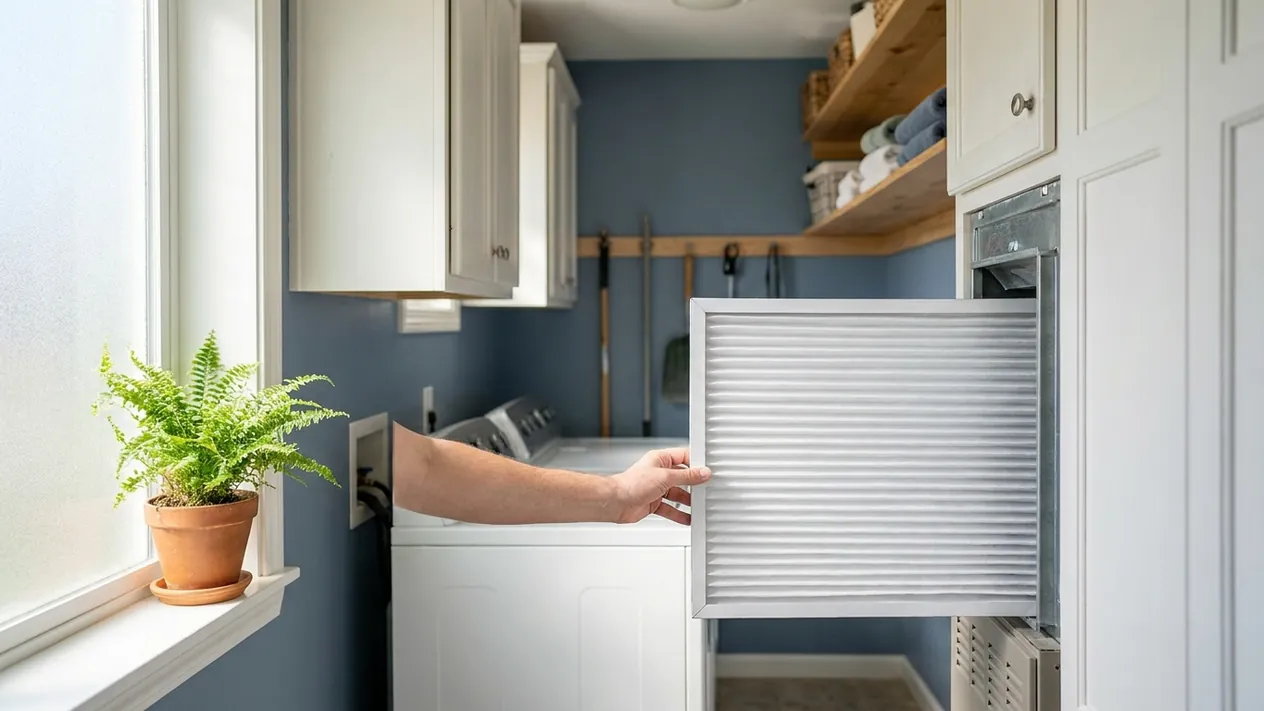
The Most Neglected 5-Minute Maintenance Task in Your Home
Your HVAC system moves hundreds of cubic feet of air through your home every single hour. Every bit of that air passes through your filter, and if that filter is clogged, your system has to work harder, your energy bill climbs, and the air your family breathes gets worse. The good news: changing your filter takes about five minutes and costs less than a cup of coffee. It's one of the highest-return maintenance habits you can build.
Why Your Filter Actually Matters
Most people think air filters are just about air quality. They're half right. Your filter does two important jobs:
- Protects the equipment. The filter's primary job is to keep dust, pet hair, and debris out of your blower motor, evaporator coil, and ductwork. A clogged filter starves your system of airflow, causing the evaporator coil to freeze and the motor to overheat. That turns a $5 filter into a $1,500 repair.
- Improves air quality. A clean, high-quality filter traps pollen, mold spores, pet dander, and fine dust before they circulate through your home. This matters especially if anyone in your household has allergies or asthma.
Step 1: Find Your Filter and Note the Size
Your filter is almost always located in one of two places: in the air handler cabinet itself (usually in a utility closet or attic), or in a return air vent on your wall or ceiling. The return vent is typically the large louvered vent that pulls air in rather than blowing it out. It's bigger than your supply vents and doesn't blow air when you hold your hand near it.
Pull the old filter out and look at the cardboard frame. You'll see three numbers printed on the side, something like 16x25x1 or 20x20x4. That's width × height × depth in inches. Write this down or snap a photo before you go shopping. Filters must fit snugly. A loose filter lets air bypass it entirely and defeats the whole purpose.
Step 2: Understand Filter Types
Walk down the filter aisle at any hardware store and you'll find four main types. Here's what you're actually looking at:
| Filter Type | Cost | Lifespan | Best For |
|---|---|---|---|
| Fiberglass (flat) | $1–3 | 30 days | Basic equipment protection only |
| Pleated (standard) | $5–15 | 60–90 days | Most households: good balance |
| Pleated (high-MERV) | $15–30 | 60–90 days | Allergy/asthma households, pets |
| Washable/Permanent | $25–60 one-time | Years | Those who want to skip buying filters |
Step 3: Decode MERV Ratings
MERV stands for Minimum Efficiency Reporting Value. It's a standardized scale from 1 to 16 that tells you how fine a particle the filter can trap. Higher is not always better for residential use:
- MERV 1–4: Fiberglass filters. Catches lint and large dust. Essentially useless for air quality.
- MERV 8: Standard pleated filter. Catches dust mites, pollen, mold spores. Fine for most homes with no pets or allergies.
- MERV 11: Catches pet dander, fine dust, some smoke particles. Good for pet owners.
- MERV 13: The sweet spot for allergy and asthma sufferers. Catches bacteria, some viruses, smoke. This is the residential sweet spot if air quality is a priority.
- MERV 14–16: Hospital-grade. Restricts airflow significantly in most residential systems and can actually harm your equipment unless your system is designed for it.
Step 4: Replace the Filter (Step by Step)
- Turn off your HVAC system at the thermostat. You don't want it kicking on while the filter slot is open and unfiltered air is getting pulled through.
- Open the filter compartment. Return vents usually have two latches or screws. Air handler cabinets have a panel door or a dedicated filter slot.
- Slide out the old filter. Hold it flat. A clogged filter can drop a significant amount of dust if tilted. Slide it into a garbage bag immediately.
- Check the slot for debris. Shine a flashlight inside and wipe any obvious dust buildup around the edges with a damp cloth.
- Install the new filter. Look for the airflow arrow printed on the filter frame. It should point toward the air handler (away from the return air, toward the blower). Installing it backward reduces effectiveness by 50%.
- Close up and turn the system back on. Done.
How Often Should You Change Your Filter?
The one-size-fits-all answer of "every 3 months" is a starting point, not a rule. Your household situation changes the math significantly:
- Single occupant, no pets, mild allergies: Every 6–12 months for a MERV 8.
- Average family of 3–4, no pets: Every 90 days.
- One pet (cat or dog): Every 60 days.
- Multiple pets or someone with allergies: Every 30–45 days.
- During heavy pollen season (spring/fall): Check monthly regardless of household size.
The real answer is simple: pull the filter out and look at it. If it's gray and clogged, change it. If it still looks relatively clean, give it another 30 days. You'll quickly learn your home's rhythm.
Set a Reminder So You Don't Forget
The biggest reason filters go unchanged for a year is not laziness. It's out of sight, out of mind. Set a recurring reminder in your phone right now. If you use a smart home assistant, ask it to remind you monthly to check the filter. Some HVAC apps and smart thermostats (like Ecobee and Nest) can send filter reminders automatically. You can also sign up for a filter subscription service that ships filters to your door on a schedule. Filtrete, Nordic Pure, and FilterBuy all offer this, and the cost is comparable to buying at the store.
Tools You'll Need
- Pleated HVAC Air Filters (MERV 8, standard households)
- High-MERV Air Filters (MERV 11–13, pets/allergies)
- Washable Reusable HVAC Filter
- Measuring Tape (for sizing your filter slot)
- Air Filter Subscription Service (Filtrete/FilterBuy)
That's it. Five minutes, a $10 filter, and you've just protected a $5,000–$15,000 piece of equipment and improved the air quality in your home. Do it today.