
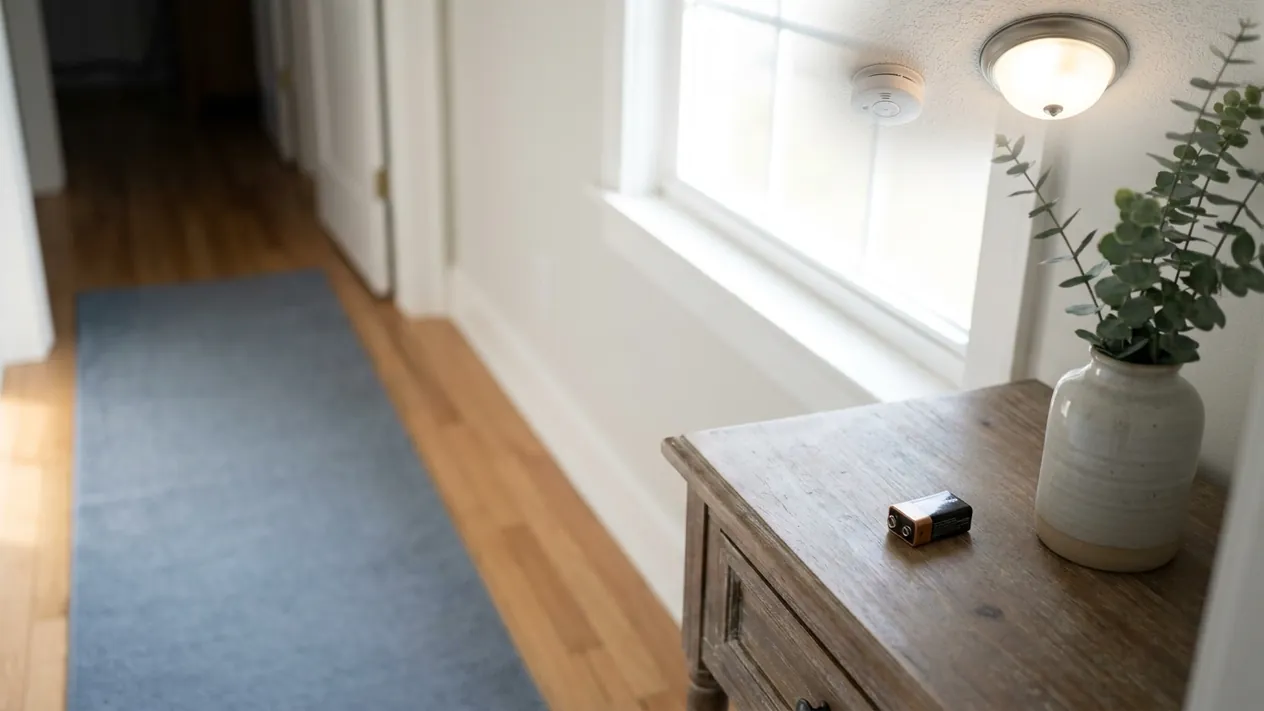
Working smoke and carbon-monoxide (CO) alarms give your household a warning when it matters. The U.S. Fire Administration recommends monthly smoke-alarm testing and replacement at the end of the alarm's service life. The CPSC recommends monthly CO-alarm testing too. Use this guide to check the alarms you actually own, then follow each model's instructions for battery type, placement, and replacement date.
Testing Your Detectors Monthly
Test every alarm monthly using its test button and the manufacturer's directions. Let people in the home know you are testing, press the button as directed, and confirm the alarm sounds. If it does not, check the power source and manual; replace a removable battery if needed, and replace or service an alarm that still fails. A button test checks the alarm electronics and sounder; for CO alarms, the CPSC notes it does not prove sensor accuracy.
Understanding What the Beeps Mean
Alarm and low-battery patterns vary by model. Read the instructions printed on the alarm or in its manual instead of using a universal beep chart. If a smoke or CO alarm sounds as an emergency alarm, get everyone outside and call emergency services from a safe location. Do not dismiss a CO alarm because no one feels ill; CO is colorless and odorless. If you suspect a natural-gas leak, leave and contact the gas utility or emergency services from outside.
If you plan to use a portable generator during an outage, see our generator safety guide for outdoor placement, CO alarms, and electrical connections.
Battery Replacement Schedule
Check whether each alarm has a replaceable battery, a sealed long-life battery, or hardwired power with a backup battery. Follow the model's instructions. For traditional 9-volt smoke alarms and hardwired units with replaceable backup batteries, the U.S. Fire Administration recommends replacing the battery at least annually and sooner if the alarm signals low battery. A sealed-battery unit normally requires replacing the whole alarm when its battery or service life ends; do not try to open a sealed battery compartment.
Write the installation or manufacture date in your home records and inspect the date label on each unit. A chirp can mean low battery, malfunction, or end of life depending on the model, so use its manual rather than guessing from the number of chirps.
When to Replace the Entire Unit
Replace smoke alarms 10 years after their manufacture date, or sooner if the maker directs or the unit fails. The U.S. Fire Administration gives the 10-year smoke-alarm rule. CO and combination alarms have model-specific replacement ages; check the date label and instructions and replace at the end-of-life signal. The CPSC advises following the product literature or asking the manufacturer for the CO-alarm replacement age.
If an alarm repeatedly sounds, fails testing, or has a damaged housing, address it promptly. A successful button test does not mean the alarm can be kept beyond its replacement date.
Where to Place Detectors
Put smoke alarms inside each bedroom, outside sleeping areas, and on every level, including the basement. The U.S. Fire Administration recommends interconnection so one sounding alarm activates the others. It also advises ceiling or high-wall placement according to the manufacturer. Keep smoke alarms at least 10 feet from cooking appliances to reduce nuisance alarms, as USFA illustrates.
Install CO alarms on each level and outside sleeping areas according to the model's instructions; CPSC gives this general placement guidance. Check local requirements and ask the fire department or a qualified electrician if you are unsure about a hardwired or interconnected setup.
Interconnected vs. Standalone Detectors
Standalone alarms sound at their own location. Interconnected alarms sound together when one detects a hazard, making a warning easier to hear elsewhere in the home. Options include compatible wired or wireless systems. Check the products' compatibility and the installation instructions; a qualified electrician should install hardwired alarms. Do not assume two alarms from different product lines will communicate simply because both say “interconnected.”
Smart Detectors
Some connected alarms offer phone notifications or accessibility features such as visual or bed-shaker alerts, depending on the system. Compare the actual model's listed functions and backup power. A phone notification does not replace an audible or accessible in-home alarm. If someone may not hear a standard alarm, ask the local fire department or an accessibility specialist about alert options suited to that person.
What to have on hand
- The manual or model number for every alarm.
- The correct replacement battery, if the alarm uses one.
- A stable step stool for a reachable alarm; ask for help rather than stretching or standing on furniture.
- The manufacture or replacement date recorded where you can find it.
Test the alarms this month, replace any unit that has reached its service life, and record the next check. If you cannot confirm an alarm works or whether it is expired, ask the manufacturer or local fire department for help.